The predominant story is not about the Christian nativity. On the contrary, this is secondary, only superficial – a justification, something we are almost embarrassed about. Instead, we are telling the story of ourselves. It is a story about what we consider to be genuinely Swedish.
The Christmas season gives us the excuse to indulge ourselves in a romanticising national self-image. This is based on a narrative reflecting not so much the truth, but the belief that if there is truth, it is resides somewhere in the past.
Perhaps this is the year of your first corporate julbord
Literally, this translates as Christmas table. In practice, we are talking about a buffet. A buffet of heavy foodstuffs traditionally served at most festivals and celebrations. This stage set is rural and abundant, telling the story of diligent peasants (- Lutheran!) enjoying the fruits of their work at the end of the year.
Pickled fish and meats in all forms, supported by no-fancy potatoes and breads, defying contemporary dietary ideology and Instagram aesthetics.
And this is important. Introducing something contemporary, or worse, new, would be heresy. The purpose of this celebration is to reinforce the idea of stability, as the opposite of change. In this context, tradition becomes a marker of what is genuinely Swedish. Obviously, this is illusory. And of course, as for anything we are keen to preserve, this is a direct consequence of its inherent ephemeral qualities.
Let us take the example of the very highlight – köttbullar
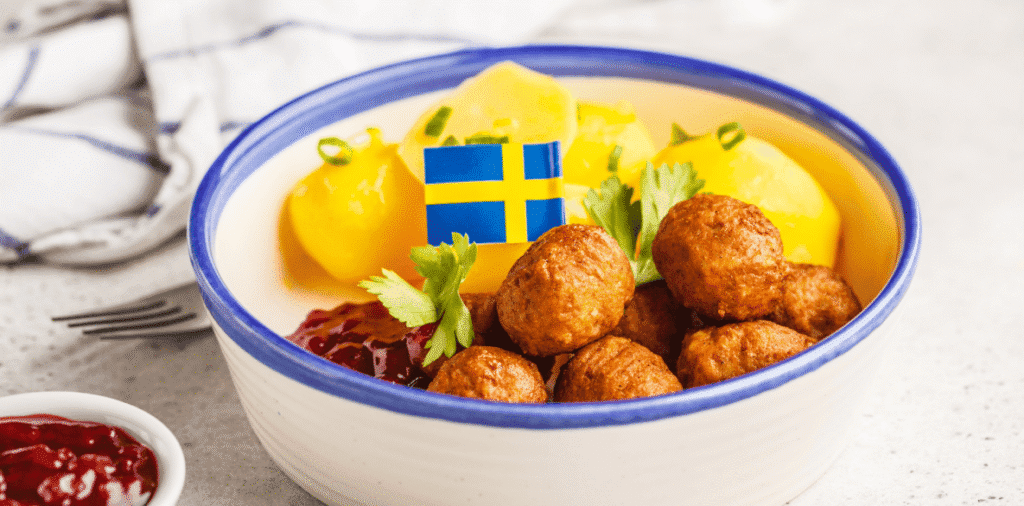
We are, naturally, talking about the most mundane constituent – köttbullar. You know, these famous meatballs served with jam all year round. At IKEA, globally and at home locally. Thawed and fried hastily or not at all, feeding starving pre-school kids, growing teenagers, nostalgic hipsters, conservative couples, non-imaginative singles. Enjoyed on paper plates, in sandwiches, on first-class china, straight from the pan. In a range of formats, from hand-rolled to mass-produced, big to small, everyday to occasional, there are still unwritten rules on how they can be prepared and served, and in what context.
Köttbullar play a curious role in Swedish national identity. When my (French) parents in-law put them in a salad – salad – I had to count to ten before not telling them this was nothing but a crime.
So, where do köttbullar originate from?
The answer is as straightforward as it can get. Turkey. King Carl brought them back from the Ottoman Empire in the 18th century. Going through various adaptations, they saw their big breakthrough with industrialisation (very late 19:th century in Sweden) where the concept of husmanskost, as we know it now, was introduced. Turkey does not sound like a genuinely Swedish place. Your conclusion is right; there is nothing very Swedish about them. 300 years ago, they were unknown in this country, 200 years ago, served once in a while, and 100 years ago – suddenly, something we had served for centuries.
In fact, meatballs can be found all over the planet. Of course, made from different animals, in different sizes, with different spices and herbs, and served with different carbs and different condiments. But there is definitely nothing uniquely Swedish about the dish in itself, if, and this is a significant if, we define something genuinely/typically/authentically Swedish as something that has been done in Sweden for a long time. Actually, if we are looking for any phenomenon fulfilling these criteria, we will not find anything that tells the story of only one country or culture.
That said, there are things that are typically Swedish.
Right now, for me, köttbullar, boiled potatoes, brown sauce, which I hate, lingonberry jam. For my parents in-law, apparently, köttbullar in a salad. For me, right now, köttbullar, potatoes, sauce and jam. Ten years ago, when I was living in the UK and conveniently picked up my köttbullar from IKEA, what I missed the most was Swedish milk. For me, in ten, twenty or fifty years, something different. For you, something different.
Further reading